 |
|
|
|
You are in: Future Trends : The Death of Economics
The Death of Economics
This page is intended to provoke debate concerning the currently dominant role of traditional economics in human decision making. Despite my contentious choice of title, I should state from the outset that I am not advocating that in the future economics will no longer matter at all, as to individuals, businesses and governments on a basic financial level it most certainly will. Also, as somebody who spent seven years studying economics at school and then at university -- and who later even spent a couple of years actually teaching economics at a degree level -- I am also not in any way suggesting that people should not learn about economic principles. Economics is an interesting and relevant discipline to study. The increasingly problem, however, is that economics is no more than a discipline, and hence ought not to have become so heavily relied upon as an almost total belief system. As I explain in depth in my book Seven Ways to Fix the World, in calling for the "death of economics" I am proposing that we ought to stop relying quite so heavily on traditional economic logic as the primary decision making mechanism of human civilization. Today, more people believe in the power of economics than in any one church, with economists worshiped in the media and by most politicians as all-knowing gods. We also now collectively place the welfare of the economy above the failing health of the planetary ecosystem that keeps our species alive. Community and equality are additionally frequently trampled by out-of-control market forces. None of the above is remotely sensible, let alone sustainable. Most people are just as concerned about their family, friends, health, religion, the environment, their national identity -- and all sorts of other human things -- as they are about economics and the monetary economy. It is therefore high time to put economics back in its place as just one tool in humanity's resource allocation and decision making toolbox. A Blessing and a CurveIn Seven Ways to Fix the World I argue that there five key reasons why traditional economic decision making will increasingly fail us all. In short, the problems are that:
Below I will briefly outline the issues associated with each of the above -- though for a complete explanation you will just have to read the entire book! :) The Folly of Constant GrowthProbably the most significant problem with a traditional economics is its ever-ending pursuit of constant economic growth. Today, economists, politicians and media organizations worldwide have become obsessed with economic growth, with a flat or shrinking economy considered a very, very bad thing indeed. Economists and politicians tell us that economic growth creates jobs and prevents stagnation. They also rely on the fact that economic growth leads to inflation that in turn devalues long-term government debt. This means that, by the time government debt has to be repaid it is worth far less in real terms. If we had no economic growth, then governments, countries and their citizens would actually have to start living within their means. And in the age of the consumer society, few seem to be responsible enough to want to do that. Regardless of what governments and even their populations are willing to accept, the finite resources of Planet Earth mean that economic growth will have to come to an end sooner rather than later. For decades, we have also only been able to achieve constant economic expansion by systematically destroying the planetary ecosystem that keeps us alive. Or as renowned biologist David Suzuki has argued, we have somehow raised the welfare of the global economy above the survival of the biosphere. And this is nothing short of suicidal. For traditional economics, the pursuit of a stable or shrinking economy is unthinkable. And yet a stable or shrinking economy is what will be required if our civilization is not to soon hit a brick wall far greater than that of the credit crunch. Fortunately, some at least are now promoting our future requirement for zero growth. For example, the Centre for the Advancement of a Steady State Economy (CASSE) has published an impressive document called Enough is Enough. This it describes as "the single most complete collection of policy initiatives, tools, and reforms "that would result in a zero-growth economy focused not on making more, but simply "enough". Ignoring the ConsequencesAnother reason that economics is failing us is that its practice just assumes away "externalities". In other words, traditional economics ignores consequences that are not given a monetary price. Not least, pollution, resource depletion, climate change and the welfare of future generations are beyond traditional economic comprehension. They are hence gleefully cast aside as irrelevant in the pursuit of short-term greed and me-first profit. Fortunately, more and more people are starting to realize that, just because they are economically able to do or buy something, this does not mean that they actually should. And we are not just taking about taking into account the survival of the planet or future generations here. In addition, considering the consequence behind the price is starting to drive customers away from clothing produced in sweat-shops, as well as towards fair-trade products and free-range food.
Failing GlobalizationAs I discuss on the more local living page, globalization is the cancer of the modern age. Over the past few decades, economic logic has driven manufacturing to the global location where labour is the cheapest. But in the process it has also left many nations without the domestic ability to feed and clothe their citizens, let alone to provide them with many basic consumer goods. So long as the oil is available to allow so much of what we buy to travel hundreds or thousands of miles, this is perfectly OK. But with Peak Oil just around the corner, the house of cards of globalization is a very dangerous state of affairs indeed. The economic logic that has driven globalization does not recognize the fact that we are burning up millions of years of stored photosynthetis in just a few hundred years. Nor does economics in any way attempt to take account of the implications of polluting the atmosphere with so many billions of tonnes of burnt fossil fuels. Adam Smith -- the founder of modern economics -- argued that free markets were needed to improve the welfare of citizens. Unfortunately, his ideas have been perverted and distorted to such an extreme that today globalization has resulted in a totally unsustainable system of food production and manufacturing that is fuelling climate change, causing the citizens of poorer nations to be exploited, and which has left the populations of many "developed" nations in a dangerous state of impotence. Human Values IgnoredIt is becoming increasingly obvious that economics-first resource allocation is getting increasingly out of step with the mood and values of the global population. As the rise of the Occupy Movement illustrates, more and more people are just not happy with the way capitalism is being practiced, let alone the way it is headed. Not least this is obvious within the Euro Zone, where the total economic folly of the single currency has been allowed to bring a continent to its knees. With austerity dominating so much of the "developed" world, politics remains dominated by futile attempts to revive and expand Western economies that are probably in terminal decline. Indeed, there is a great danger that far too many resources are being invested to try and mend broken systems, rather devoting time and energies to develop new mechanisms for resource allocation and decision making that may help us respond positively to those many future challenges of the next few decades. To provide a glimmer of hope, at least a few pioneers are now thinking ahead. For example, a "global sustainability advocacy group" called the Zeitgeist Movement is proposing a transition to a "resource based economy". This would be governed by the application of the best scientific knowledge, rather than by monetary or political principles. Environmental Challenges UnresolvedEconomics is proving time and time again that it is incapable of dealing with fundamental challenges, and in particular the problem of climate change. Indeed, the Stern Review produced for the UK Government freely admitted that "climate change is the greatest and widest-ranging market failure ever seen". Systems of "carbon trading" that create a market in exchangeable carbon emission allowances are also proving a dangerous farce, with the plian fact of the matter remaining that market mechanisms are good only for promoting short-term, profit-generating behaviour. To tackle the environmental fallout of mass capitalism before it is too late, we simply have no choice but to adopt response mechanisms other than those that directly fuelled the problem in the first place. Beyond the Short-TermWhat all of the above hopefully reminds us is that economics promotes short-term thinking. Economic guru John Maynard Keynes did, after all, once famously dismiss the future implications of traditional economic activity with the line "in the long run we are all dead." Except, of course, while we may be dead, our children and their children will still be alive and cursing our folly. The selfish, debt-driven mass consumption of the Baby Boom generation has already bankrupted the youth of today. But this inter-generational crime is as nothing compared to the implications of us continuing to run the world according to economic principles that are increasingly laying waste the future of billions. For human civilization to survive, we need to start valuing the future as well as the present. We will also need to accept some constraints on our individual freedoms to act and consume as we please. This will all only have a chance of happening if a great many people start to think and act collectively as part of an emerging but as yet unnamed belief system that recognises the value and necessity of developments including more local living, low energy lifestyles, dematerialization, design for repair, crowdsourcing, and placing more women in authority. This topic is discussed in more depth in my book Seven Ways to Fix the World. Return to Future Trends.
|
 We need to stop to relying so heavily on traditional economic logic as the primary decision making mechanism of human civilization. 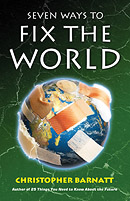 Read more in this book |


 |

|